I received a comment on my blog this morning from a lady who resides in Richmond, British Colombia. I have family out that way - now on Vancouver Island at Nananimo. It made me think of them, I hadn't thought of them in a while. My Aunty Bobbie had passed away from Breast Cancer some two years before I was diagnosed with it. She was my Godmother as well as my Aunt, so I felt the blow of loosing her twice. It reminded me I should write to my cousins and my Uncle.
Anyway, back to the lady in Richmond, BC. She wanted my recipe for Damson Gin. After its appearance at our Diamond Jubilee Party (you can see the photographs here) as a cocktail, which was a very simple concoction; like a Kir - one fat finger of Damson Gin in a wine glass and topped up with dry sparkling white wine. Two litres of my home-made Damson Gin and and 2 cases of wine disappeared down the hatch that afternoon. Everyone was very merry!
I was at my apiary in the orchard on Monday night preparing the bees for winter and treating them for varroa mite so that their strength wouldn't be sapped by these parasite during their winter rest. I noticed that a lot of the Damson's had changed colour and the drupes were dark purple-blue with their unmistakable bloom. I felt a few to see if they were ripe, they had been this time last year, and many of them gave a little under the pressure of my fingers. I decided to pick just enough to make Damson Gin. Filling all the pockets on my bee suit is usually the right amount.
Damson Gin
You will need:
1kg White sugar
1kg Damsons
Gin; probably need about 1.5 litres
Method
Damson Gin is simplicity itself. First pick or buy your Damsons. You will need about 1 kilo for the way I do it, but you can always prorate the quantities up or down to suit your taste. You don't have to be pedantic about weights in this either, a bit more or a bit less won't change things very much.
Once you have your damsons, you need to wash them and then damage the skins as they are tough, and you need the gin to be able to get through the flesh so they can macerate. There are lots of ways to do this. Some people prick the skins with a darning needle. Others freezer the damsons, and this caused the skins to rupture. Or I just use a sharp knife and make a few cuts through the skin and flesh to the stone. You don't have to be pretty about this. They wont be in the final product, although you can add them to a crumble or make chocolates with them, so don't throw them away when the first stage is complete, they are perfectly delicious reused.
Make sure the Kilner jar is clean and sterile and free from odours of the previous food you had in it. (you can do this exactly the same way as you would to sterilise jam jars for preserves and pickles)
Place the washed, and cut/pricked/frozen damsons in the jar whole, leave the stones in. Then place the sugar on top of this. Now simply top up with Gin leaving a gap at the rim so that you can agitate it easily. Close the jar and make sure it is a good air tight and liquid tight seal - you are going to be working the bingo wings over the next few days, and you don't want to end up having a Damson Gin shower.
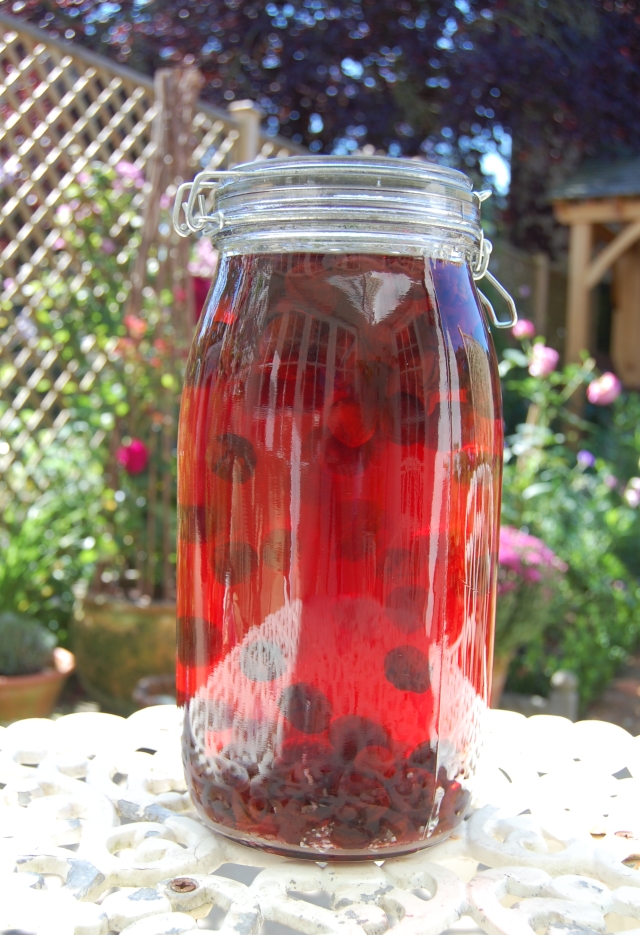
Pick up the jar and shake it vigorously. The idea is to get the sugar to dissolve. This will take a few days, and leaving the jar on a sunny window sill will soon speed the is part of the process along. The jar in the photograph above was made on Tuesday evening, and as you can see, most the sugar has dissolved and a clear ruby coloured liquid is beginning to emerge. This will darken as time goes on. Shake the jar as often as you like, the quicker the sugar has dissolved, the quicker you will get on to the next stage.
When all the sugar has dissolved into the Gin, place the Jar in a cool, dry, dark place - it's going to sit here for at least 6 months to macerate. I usually give it a gentle shake about once a week during this period. You can leave it longer, it really doesn't matter too much.
Once 6 months have passed, I pass the whole concoction through a double layer of muslin, and bottle it using air tight closures. I prefer corks, but you need special equipment to push corks home in bottles, so screw tops and clip tops are just as good. I use a cork because it means I can recycle bottles and not have to buy them specifically, although most the Damson Gin I make gets given away anyway!
The longer you can leave the Gin undrunk, the smoother it becomes. I know the temptation is hard to resist, but by the time its 18 months old, it just slips down, and if you allow it to become 5 years old, its is nectar. Sláinte!
Comments
I must get picking myself :D
Sheila (Richmond)