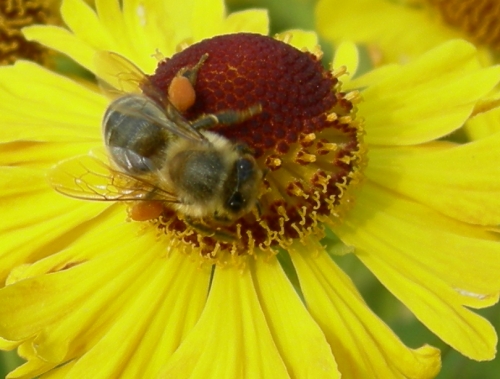
Bees have always fascinated me, regardless of which species, their selfless industry is an example to us all. Without the bees, we will be in dire straits indeed, as many crops, especially fruits are dependant on them for pollination, and the subsequent crops of apples, pears, and many other ordinary every day foods we take for granted.
In hazy summer days in my garden in years gone by, the buzz of insects, and especially honey bees was the background track I listened to as I worked or lazed. A steady soothing low toned buzz, that only varied slightly as each insect flew from flower to flower, drinking nectar and collecting pollen for later turning into honey via a mystical chemical process, that we still don't full understand today.
Honey and its by products have be attributed with all manner of magical and healing powers over the millennia, and bees go far back in our human history. We can not tame or domesticate them, but we have learned to exploit their activity. Honey has many uses, from a delicious food we can eat, to natural antibiotic, useful in the healing of wounds, and frequently found in folk medicine. The wax is used to create clean burning candles, and the ancient monasteries that created works of great beauty such as the Book of Kells, and the Lindisfarne Gospels, kept bees for these very reasons, to heal, and to make candles so they had better light for the creation of illuminated manuscripts. Royal Jelly has been attributed with many properties throughout history, and Propolis, a resiny type excretion used by the bees to fill gaps and resurface areas within a colonies home, whether it be a tree hollow or a hive, has been used in the production of varnishes, and a multitude of health supplements, and we continue to use them today.
Sadly, bees are in serious decline, in part due to a parasite that has travelled from Asia; the Varroa mite. Recent research indicates a 'cure' may not be too far off for this, and out western Honey bees may get the help they need to battle this parasite and help prevent colony decline and death. More worryingly, however, are the recent reports of chemicals being used in farming called Clothianidin are having a highly toxic effect on bee populations and directly contributing to the massive collapses of bee colonies.
So what can we do about it - there are the usual channels, lobby your MP, MEP, or other government officials depending on your country of origin. Stop using pesticides and chemicals in your own gardens, and try and encourage bees by planting crops and flowers vital to their life cycle.
I have done all this, and have decided to take it a step further, and keep bees too. To this end I started taking classes with a local Bee-keeping Association, and so far have spent many happy hours learning the theory of bee keeping, their life cycle, about how to maintain healthy colonies, and everything I need to know to keep happy healthy bees. This week we were handed some frames to inspect. They had the ubiquitous hexagonal wax cells on them created by worker bees. Close your eyes and inhale the fragrance and it takes you straight to a fragrant barmy July day. The perfection of each cell was remarkable, and we learned to distinguish the cells used for the different types of bee larva, workers, drones, and queens, and their various life cycles, and what influences how a bee larva will turn out. The chemistry is mind boggling.
The classes are very thorough and well attended, and I know both my local Associations are oversubscribed with people wanting to do exactly the same as me, and have waiting lists. Like allotments, it seems to be the latest thing to interest those of us who are concerned about the world we live in, and how we can make a small contribution to trying to maintain the status quo and live more lightly in the environment.
Whilst the dark nights and short days continue, we will continue with the Theory lessons, but come April, as the days warm and lengthen we are promised weekly afternoons in a apiary learning hands on about how to keep bees. I for one cant wait, although I am not sure I am looking forward to earning my wings as a bee-keeper and living up to the maxim 'You aren't a bee-keeper until you have been stung!'
I heard yesterday that there is a site in an adjacent village that I can put my own hives on, so I am very excited at this prospect and busily researching which type of hives I want and whether to follow the county standard, or go my own way, and choose a Top Bar set up, which although less productive, is a more natural way to keep bees, than the more usual set ups of brood boxes and super in one form or another. Time will tell.
Comments
Interesting too that you decided to keep bees - but not in your garden.
As an irrelevance - I've just finished reading 'The Secret Life of Bees' by Sue Monk-Kidd. It impressed me more than any other novel I have read recently.
Good luck with the renewed blogging, Zoe. (With dots on - I don't know how to put them there.) Good luck with the bees. Good luck bees!
Esther
The part where you discussed taking in the smell of the the frames etc really had me reminiscing only to be reminded that we're most certainly still in the grip of a very cold January.
My friend wants me to go to classes with her and I also want to keep bees in the future so who knows what will happen.
Please keep us updated on your progress and when you have all that lovely surplus honey give me a buzz (seems as though i've punned too)! ;)
I've always felt a little suspicious of bees (and the Bedsock who seemed to enjoy it too much) since then.
Blog is looking gorgeous, Zoe. xxxxx
Do be careful of your lymphoedema arm - don't get stung there! Looking forward to hearing about progress with your hives...and eventually yummy honey :)
The site is over at Greywell, seem to recall you or OH had family here, there?
Ester - I would like to keep them in the garden, but my garden isn't especially large; its soon to have chickens in it, and with 5 cats, I thought I was probably tempting fate a step to far by adding beehives into the mix. Also, my eldest is terrified of them, wasps and anything bee like, even the hoverflies send him off in a tizz; something to be avoided given his stature! Also thought it would benefit me if I was around other bee-keepers, and the site I have chosen has other locals using it too, so I can benefit from it the same way I do the allotment set up, learn and enjoy the community, as I tend to isolate myself a lot most the time.
Helen - yes - think its exactly that. I couldnt get past the idea that most the hive systems used in modern apiculture are designed to get the bees to produce as much as possible for our benefit. This had me in mind of battery chickens. I know that's an extreme example, but part the point of me doing this is to benefit the bees too, so if they are happier and yield less, I am fine with that. You can acquire similar Top Bar Hives from the Cornish Honey Company.
Ryan - I was surprised how popular classes are, so I'd get your name down sooner than later as round here everything is now fully booked until next year!
Marcia - well you know what I will be bringing to the pub as a treat when its ready? Honey! We could try our own line in Mead? Hic!
Arabella - I am not in the least surprised by your deft rescue of the wine, although saddened to hear that The Sock took such glee dispatching the bee !
Jane - no I didn't realise you had bees next doors? Is this the bonkers one with the hens and the shot gun, or the Vicar? I am really excited about keeping them too, perhaps if/when we move down your way I can find a site near the moor and they can sup Heather nectar, and we can get Adrian to turn it in to a noxious ferment for us? Sloe Gin and Honey Mead cocktails anyone? Or how about honey roasted Rhubarb Bellinis?
It is the most wonderful pursuit - on all sorts of levels; from the study of the bee community and their social interaction, working with them and the reward of all that honey, wax and pollen. A world without the honey bee would be a sad an desolate place.
Really look forward to reading about your bee-keeping exploits!
Very handsome looking site too!
Understand how serious allergies are though, Robyn carries an Epipen with her everywhere after a near fatal encounter with a Chicken Tikka Masala ( cashew nuts). Not to be taken lightly!
What sort of Hives did you have?
We tried to start an apiary in the community orchard, via U3A but some townie types freaked out at the idea of having bees in the orchard (how else do they think the fruit gets pollenated?) and threatened to sue the Parish Council if they got stung and claimed it was 'reckless and irresponsible'. You can't sue for a bee sting, as Bees are classed as wild animals, but the thought of any litigation was enough to send our Parish Council into retreat clutching tightly to the purse strings, as such civil cases are horribly expensive to defend. Quite ridiculous, but then the same people complain about hens clucking, horses neighing, and cows lowing, and yet drive round in hugely powerful and noisy cars. You have to wonder why they chose to live in a rural location at all *shrugs*
I read somewhere that top bar hives can help prevent varroa mite as the bees create the hive as naturally as possible and this means the individual cells are smaller, preventing the mites from being able to get in. Apparently the bees are less stressed in this environment too, as they're (nearly) living as they have evolved to do.
Noticed that you've vanished from Twitter - glad to find you here blogging merrily.
yes Twitter is now ancient history, but glad to see you made it here; my son told me you had asked about me, so I am glad he was able to let people know I was about. Just far less visible.
Understand the nervousness, Son shares that with you, which is one reason why I decided not to keep them in the garden, think he would have flipped!
Good on yer. Beekeepers of the world, unite!!